

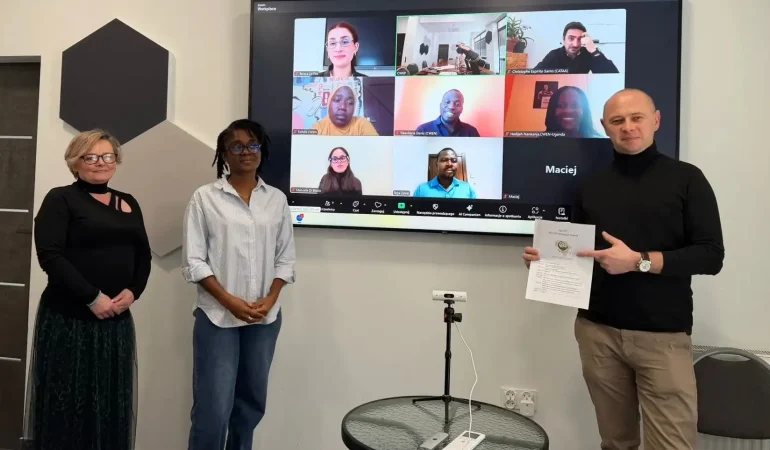
AgriVET Project Start-Up Meeting in Rzeszów, Poland
The AgriVET project, being implemented in sub-Saharan Africa with support from the European Union, began implementation in January 2026 and held its first coordination meeting in Poland on the 11th and 12th of March 2026. The agri-food sector is a cornerstone of global food security and economic development. In sub-Saharan Africa, agriculture employs the majority of the workforce and remains the main route out of poverty for millions of people. In European contexts, the agri-food industry is just as vital, underpinning rural economies, cultural heritage, and export competitiveness.
It was this shared importance, seen from two very different sides, that brought together a six-partner consortium from Africa and Europe: Citizens Information and Development Initiative (CIDI), Mobile Business Clinic Africa (MBC Africa), Community Women Enterprise Network Uganda Limited (CWEN Uganda), Exeo Lab S.R.L., and CATAA – Associação Centro Apoio Tecnológico Agro-Alimentar de Castelo Branco, led by Stowarzyszenie Centrum Wspierania Edukacji i Przedsiębiorczości (CWEP). Together, they set out to explore what cross-border learning could do to strengthen vocational education and training (VET) in agriculture, bridging two regions that rarely get the chance to compare notes directly. On one side sit three European partners, from Poland, Italy, and Portugal, bringing years of established VET methodology. On the other are three African partners, from Nigeria, Ghana, and Uganda, bringing deep knowledge of the on-the-ground realities that agricultural training has to work within.
The project’s work is organised into five Work Packages, with a Steering Committee and a dedicated Quality Management Committee responsible for keeping delivery on track and aligned with the standards set out in the original proposal. Much of the project’s success will depend on how well six organisations, working across six very different contexts, are able to communicate and collaborate, and the kick-off meeting was the first real test of that. Six organisations were represented at the meeting: Maciej Markowicz for CWEP; Manuela Diblasio and Teresa Lo Tito for Exeo Lab; Christophe Espírito for CATAA; Tega Edeki for CIDI; Adwoa Duffuor for MBC Africa; and Hadijah Nankanja for CWEN. In total, about seven representatives from five countries came together for one course for two days.
The meeting covered the essentials of getting a consortium project off the ground. After introductions and the formal kick-off, partners turned to governance, establishing the Steering Committee that will guide the project’s overall direction, along with the other management bodies it needs, including the Quality Management Committee, which is responsible for holding results to the standards set out in the proposal. The rest of the time was spent on what mattered most: a detailed walk-through of the Work Packages, with partners giving each other direct feedback on progress and next steps.
Participants rated the meeting itself, and how useful it was, highly, with an average score of 4.82 out of 5. Many noted how well the sessions were run, how clearly the team communicated, and how well time was managed throughout. The working atmosphere scored almost as well, at 4.79, with partners saying they felt genuinely heard and had real opportunities to contribute rather than simply sit and listen. Confidence in the technical substance of the project was also strong: satisfaction with the Work Packages averaged 4.74, though Work Packages 4 and 5 scored slightly lower than Work Packages 1 to 3, suggesting these two may need clearer explanation in future meetings.