

Community-Centered Approach
- Citizens Information and Development Initiative (CIDI)
- Community-Centered Approach
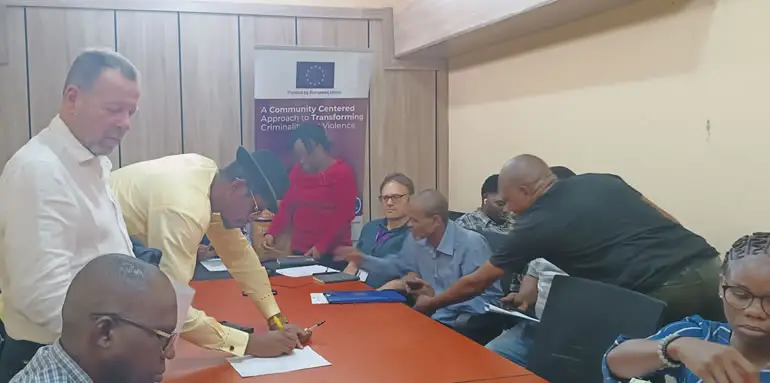
A Community-Centered Approach Towards Transforming Violence and Conflict the Niger Delta
SUPPORTED BY | The European Union and Search for Common Ground |
|---|---|
REGIONAL SCOPE | Niger Delta, Nigeria. |
DURATION | 18-Months |
GOAL | Fostering inclusive community security approaches to address the systemic drivers of violence and criminality in Bayelsa, Delta, and Rivers States. |
PROJECT OBJECTIVES | |
Specific Objectives
| |
CONTEXT | |
The Niger Delta is one of Nigeria’s poorest regions: in Bayelsa, 88.5% of people are considered multi-dimensionally poor, compared to 62.9% nationally. Across the region, unemployment on average is over 40%, significantly higher than the national average. Youth unemployment is a particular challenge; in Delta, it is estimated at 64%. Young people are also more likely to believe that they are discriminated against based on their economic status: In Bayelsa, 72% of 15-25-year-olds and 87% of 25-35-year-olds reported “always” being discriminated against by the government, compared to 61% of those 65 or older. A systematic analysis conducted by AAPW found that in the target states, unemployment, poverty, drug abuse, arms proliferation, and political manipulation were among the key drivers of diverse forms of violence, including cultism, political thuggery, kidnapping, oil bunkering, and artisanal refining, and attacks on military and police personnel. Poor, opaque, and unaccountable governance—compounded by corruption and rent-seeking behavior— is a key driver of violence in the Niger Delta. Overall, weak governance contributes to a climate of instability by creating a permissive environment not only for oil bunkering, but also for other forms of violence (i.e. cultist, intercommunal, sexual, and gender-based) The Niger Delta is one of Nigeria’s poorest regions: in Bayelsa, 88.5% of people are considered multi-dimensionally poor, compared to 62.9% nationally. Across the region, unemployment on average is over 40%, significantly higher than the national average. Youth unemployment is a particular challenge; in Delta, it is estimated at 64%. Young people are also more likely to believe that they are discriminated against based on their economic status:In Bayelsa, 72% of 15-25-year-olds and 87% of 25-35-year-olds reported “always” being discriminated against by the government, compared to 61% of those 65 or older. A systematic analysis conducted by AAPW found that in the target states, unemployment, poverty, drug abuse, arms proliferation, and political manipulation were among the key drivers of diverse forms of violence, including cultism, political thuggery, kidnapping, oil bunkering, and artisanal refining, and attacks on military and police personnel. Poor, opaque, and unaccountable governance—compounded by corruption and rent-seeking behavior— is a key driver of violence in the Niger Delta. Overall, weak governance contributes to a climate of instability by creating a permissive environment not only for oil bunkering, but also for other forms of violence (i.e. cultist, intercommunal, sexual, and gender-based) that reify social divisions, further degrade the quality of life and livelihood opportunities, and incite heavy-handed security responses, reinforcing the structural factors of vulnerability that cause individuals to resort to oil bunkering and criminality. It is widely believed that state-level politicians in Bayelsa, Delta, and Rivers are involved in the direction of political violence and criminality, for example by employing and arming cult gangs to achieve their political goals. On the other hand, state government was also repeatedly identified by key stakeholders as having “the most effective combination of logistical capacity, and political and community reach”[1] to address criminality, emphasizing the critical role that state policymakers play in shaping the trajectory of the region and the need to strengthen their accountability and cooperation with their constituents. However, in the current context, discriminatory, absent, and weak governance reifies existing divisions. For example, ethnic bias in local government leadership and hiring in Warri, Delta State has been blamed for fuelling inter-communal conflict that has left hundreds dead and thousands displaced. Meanwhile, a Search baseline study found that conflicts between farmers and herders in Delta State over access to grazing land were compounded by the government’s inaction around dispute resolution, justice provision, and conflict prevention. This inertia was also found amongst police and security actors: 92.3% of community respondents who had shared early warning information with the police said that the info had not been acted upon, highlighting the need for greater collaboration between communities and public security actors on early warning strategies, as well as mechanisms for accountability and monitoring. | |